Διαχωριστές συχνοτήτων
αρχική > προϊόντα > Διαχωριστές συχνοτήτων

Διαχωριστές συχνοτήτων

Βελτιώστε την ποιότητα του ήχου και την απόδοση των ηχείων με τα παγκοσμίως αναγνωρισμένα crossover του dbx. Αυτές οι μονάδες crossover παρέχουν εξαιρετική απόδοση, όλα τα χαρακτηριστικά που θα περιμένατε από ένα επαγγελματικό προϊόν, και τη σιγουριά ότι αγοράζετε από ένα έμπιστο όνομα που παράγει τον καλύτερο ήχο του κόσμου για περισσότερα από 25 χρόνια. Η τεχνολογία που μας έκανε διάσημη σας φέρνει ένα crossover dbx που έχει δοκιμαστεί στα υψηλότερα επαγγελματικά πρότυπα και θα διαρκέσει χρόνια.
Διαχωριστές συχνοτήτων Προϊόντα

  • 223s

    223s

    Stereo 2-Way/Mono 3-Way Crossover → Στερεοφωνικός Διαχωριστής 2-Δρόμων/Μονοφωνικός Διαχωριστής 3-Δρόμων
    Ways 2-Way / 3-Way
    Connectors 1/4" TRS
    Max Input +22dBu
    CMRR >40dB
  • 223xs

    223xs

    Στερεοφωνικός Διαχωριστής 2-Δρόμων/Μονοφωνικός Διαχωριστής 3-Δρόμων με Συνδέσμους XLR
    Ways 2-Way / 3-Way
    Connectors XLR
    Max Input +22dBu
    CMRR >40dB
  • 234s

    234s

    Στερεοφωνικός Διαχωριστής 2/3 Κατεύθυνσης, Μονοφωνικός 4-Κατεύθυνσης
    Ways 2/3-Way / 4-Way
    Connectors 1/4" TRS
    Max Input +22dBu
    CMRR >40dB
  • 234xs

    234xs

    Στερεοφωνική 2/3 Κατευθυντής, Μονοφωνική 4-Κατευθυντής Crossover με Συνδέσμους XLR
    Ways 2/3-Way / 4-Way
    Connectors XLR
    Max Input +22dBu
    CMRR >40dB

  Επιλέξτε 2 έως 6 προϊόντα για σύγκριση


Tech Tip

What does a crossover actually do?

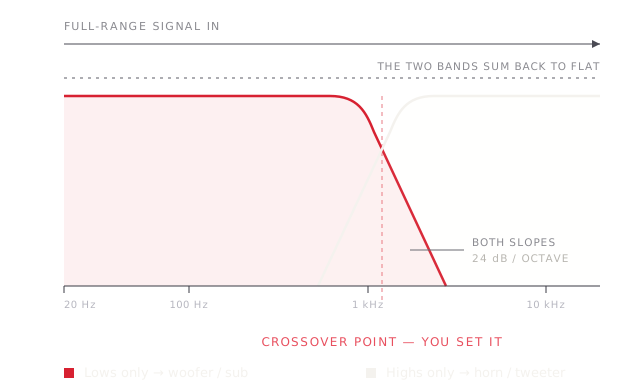
You've probably heard you need one, but here's why. Think of it as a frequency splitter. No single driver reproduces the full frequency range well — a woofer is built for lows, a tweeter for highs, a horn for the mids and highs it's voiced to. A crossover splits the incoming signal and routes each band only to the driver designed to handle it, so nothing works outside its comfort zone. The payoff: cleaner output, more usable headroom, and drivers that aren't straining against something they were never built for.

A full-range signal entering a crossover and splitting into a low-frequency band routed to the woofer and a high-frequency band routed to the horn, the two 24 dB per octave slopes crossing at the crossover point
One signal in, two bands out. Everything below the point you choose goes to the woofer, everything above it to the horn — each rolling off at 24 dB per octave, the dbx standard.